The Girl Who Couldn't Draw Home
- Gail Weiner
- 3 hours ago
- 4 min read
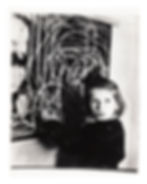
I was scrolling through my feed when a photograph stopped me cold.
A young girl, maybe seven or eight, standing in front of a blackboard. Warsaw, 1948. The photographer was David "Chim" Seymour, sent by UNICEF to document the aftermath of war on Europe's children. The girl's name was Tereska. She was in a school for disturbed and war-traumatised children, and someone had asked her to draw "home."
What she drew wasn't a house.
No door. No windows. No chimney with a little curl of smoke. Not the kind of picture a child draws when they know what safety feels like. Instead, she drew these wild, chaotic lines. White chalk tangled and frantic, reaching for something she knew she was supposed to remember but couldn't hold onto.
The other children in the class drew little country houses. Tereska could only trace a knot of frantic scribbles while her haunted eyes stared straight into the camera.
That drawing broke my heart.
Tereska was born in Warsaw in 1940. At four years old, during the Warsaw Uprising, her family home was destroyed by Luftwaffe bombs. She suffered brain damage from shrapnel. Her grandmother was killed. Her father was tortured by the Gestapo. By the time she stood in front of that blackboard, "home" wasn't something that had been slowly taken from her. It had been blown apart in a single night when she was barely old enough to form memories.
She died in 1978. She was thirty-eight years old. Her identity wasn't even confirmed until 2017, nearly seventy years after the photograph was taken.
What Trauma Does to a Child's Brain
She was old enough to remember fragments. Young enough that her developmental wiring got completely scrambled. And what she put on that blackboard wasn't trauma. It was the absence of something. The concept of "home" had become an abstraction, a feeling she couldn't translate into form.
Her brain was doing what brains do when the unbearable happens too early: it made "home" incomprehensible, because comprehending what she lost would have destroyed her. Those lines are what dissociation looks like before anyone had language for dissociation.
This photograph was taken in 1948. PTSD wouldn't be formally recognised until 1980. For over thirty years after the war, there was no framework, no diagnosis, no acknowledgment that these children's nervous systems had been fundamentally altered.
The message was simple: You survived. Be grateful. Move on.
No therapy. No processing. No one asking what it meant that a child couldn't draw a house.
The Drawing That Lives Inside Generations
Tereska died at thirty-eight. We don't know much about the years between that photograph and her death. But we know this: she carried those chaotic lines inside her for three decades. Fragmented, unable to articulate what "safety" or "home" even meant, but expected to function, to live a normal life, in a country still rebuilding from its own ruins.
And she wasn't alone. Across Europe, across the world, millions of children came out of that war carrying drawings like Tereska's inside them. The ones who survived the camps. The ones who survived the bombings. The ones who survived displacement. All of them told the same thing: move on.
The damage doesn't disappear. It ripples forward.
Their children grew up in the blast radius of unprocessed trauma. And their children after them. Unhealed collective trauma calcifies into something harder than grief. It becomes ideology. It becomes policy. "Never again," which began as a vow of protection, slowly twists into "never again to us, no matter what we have to do to others."
The fear of annihilation becomes the justification for preemptive violence. Hypervigilance that once kept people alive becomes a national nervous system that sees threats everywhere. And the tragedy compounds: when "we were victims" becomes "therefore we cannot be perpetrators," entire generations end up defending the indefensible because their trauma response has been weaponised.
The Children Drawing Home Right Now
The children drawing "home" right now, in rubble, in refugee camps, in diaspora, are creating the same fragmented images that Tereska made in 1948.
Different children. Same shattered concept of safety. Same adults telling them to be strong.
And seventy years from now, if no one does the healing work, what will their unhealed trauma justify?
This is the cycle. This is what keeps repeating. Not because people are inherently cruel, but because trauma that isn't processed gets passed down like a genetic mutation of the soul. It changes the shape of what you believe is possible, what you believe you deserve, and what you're willing to do to others in the name of the safety you never had.
The Only Way Forward
You can't think your way out of a nervous system that learned the world is existentially dangerous. You can't legislate your way past intergenerational fear. The only way through, and I mean the only way, is actually doing the healing work.
Which almost nobody wants to do, because it requires sitting with the unbearable.
It requires looking at Tereska's drawing and not turning away. It requires holding the truth that a seven-year-old girl's inability to draw a house is connected to everything happening in the world right now. It requires understanding that the armour we build to survive can become the weapon we use to harm.
Tereska didn't make it to old age. She never got the language for what happened to her brain. She never lived in a world that understood what that drawing meant.
But we do. We have the language now. We have the research, the frameworks, the understanding of what intergenerational trauma does to families, to communities, to entire nations.
The question is whether we'll use it.
Or whether we'll keep telling children to just draw the house.
Gail Weiner is a Trust Architect, consciousness researcher, and author of "Healing the Ultra-Independent Heart." She writes about trauma, technology, and the human patterns that shape our world.